RITM supports and promotes interdisciplinary graduate and undergraduate seminars that highlight critical scholarship related to race, indigeneity, and transnational migration. Each course brings leading researchers to campus for classroom discussions and public lectures.
-

Bad Bunny: Musical Aesthetics and Politics, Fall 2025
Hosted by: Albert Laguna, Associate Professor of American Studies and Ethnicity, Race, & Migration This course examined the music of Bad Bunny as a point of departure for developing skills as close listeners attentive to how cultural production creates interpretive avenues for understanding the intersections of aesthetics, history, and politics. Topics included the history of Puerto Rico and its colonial past and present (tourism, debt crisis, hurricanes); the evolution of musical forms (bomba, plena, salsa, reggaeton) and their travels across the Americas; and the Puerto Rican diaspora in New York City.
Fall 2025

Revolutionary Barcelona
Hosted by: Aurélie Vialette, Director of Undergraduate Studies for Spanish and Associate Professor Tenure
This course explored the many facets of Barcelona, a city through which students can understand social tensions, working-class revolts, Spain’s civil war and the legacies of slavery in today’s world.
Spring 2025
Beyoncé Makes History: Black Radical Tradition History, Culture, Theory & Politics through Music 
Hosted by: Daphne Brooks, Professor of African American Studies, American Studies, Music, and Women’s, Gender and Sexuality Studies
This course centered the 2010s and 2020s’ sonic and visual repertoires of Beyoncé Knowles-Carter as the portal through which to rigorously examine key interdisciplinary works of Black radical tradition, intellectual thought and grassroots activist politics and practice across the centuries. Its aim was two-fold: to both explore and analyze the dense, robust, and virtuosic aesthetics as well as the socio-historical and political dimensions of Beyoncé’s pathbreaking, mid-career body of work and to, likewise, use her distinct repertoire as a way into examining major lines of inquiry in Black Studies critical thought. In short, this was a class that traced the relationship between Beyoncé’s artistic genius and Black intellectual practice.
Spring 2024
Black Existentialism
Hosted by: Shane Vogel, Chair of Theater, Dance, and Performance Studies, Professor of English and African American Studies
This course is an introduction to Black existential thought as it developed in the writing of African American and Afro-Caribbean authors. Existentialism was a historical movement in philosophy and culture typically a sociated with mid twentieth-century European intellectuals that asked how individuals constitute themselves within and beyond the given constraints and possibilities of their situation. But a deep tradition of Black existentialism—or what Lewis R. Gordon calls Africana philosophies of existence—is related to but distinct from the European tradition. Throughout the course we explore key existential concepts such as freedom, authenticity, responsibility, action, struggle, situation, anguish, dread, the gaze, and the Other as they have been imagined in Black diasporic expressive cultures.
Spring 2023
Decolonizing Europe
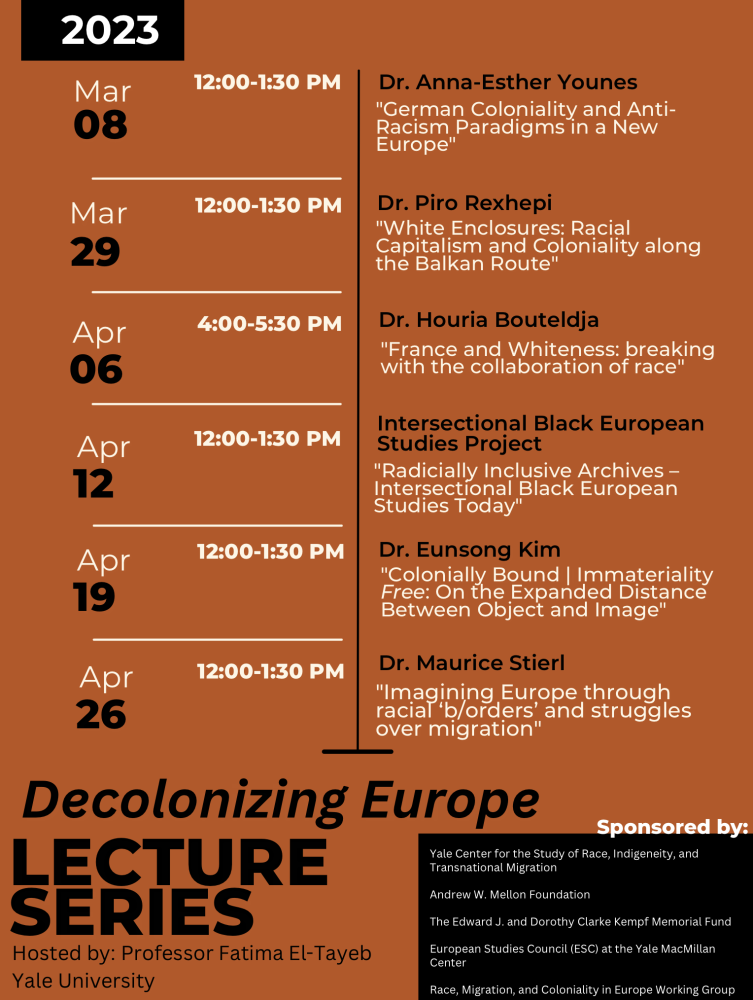
Hosted by: Professor Fatima El-Tayeb, Professor of Women, Gender, and Sexuality Studies, and of Ethnicity, Race, and Migration
Decolonial theory has become an increasingly relevant tool in imagining a world different from the one created by the dominance of Western modernity. However, it is not necessarily obvious what Europe can contribute to this process as the decentering of Europe and its intellectual traditions is one of the tenets of decolonial theory. Additionally, the continent arguably is the only one in which Europeans do not appear as colonizers. In this class, following authors such as as Aimée Cesaire, Stuart Hall, and Houria Bouteldja, we will approach Europe as a space that is key to the global process of decolonization. A return of land in the former colonies that includes actual sovereignty instead of exploitative postcolonial relationships would fundamentally change the European economy, which is built on a model of prosperity at the expense of non-Europeans, justified through a model of meritocracy that makes invisible the violence of the colonial project. But beyond that, Europe as a concept collapses without a colonial framework – what Europe stands for today (and has since early modernity) would be meaningless without the Western knowledge model that decoloniality aims to dismantle.


